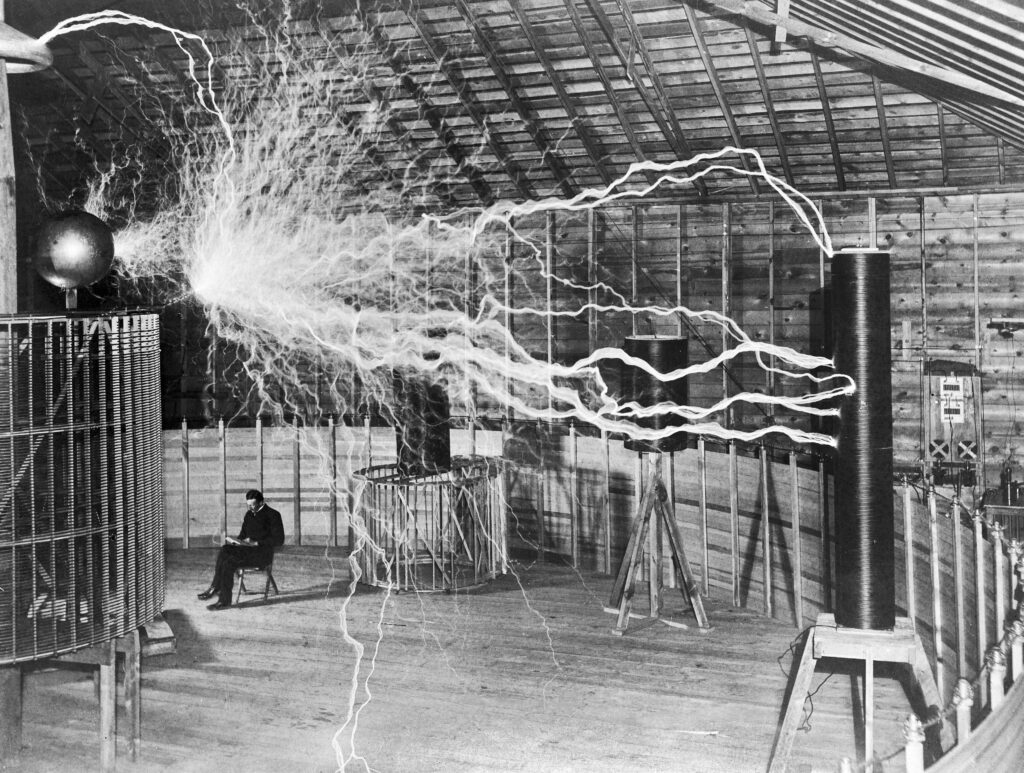
We are accustomed to finding a devotion to beauty in museums, concert halls, and collections of poetry. Yet sometimes true beauty is born not on canvas or stage, but in the laboratory – between coils, formulas, and the silence of nocturnal experiments. Nikola Tesla belonged to a rare type of person for whom science was the highest art, almost a spiritual act. He worked not for fame or wealth. His true passion was the harmony of the universe. And his entire life reads like a vast personal diary, written in flashes of electric discharge.
How Tesla “Saw” His Inventions
Tesla possessed an extraordinary gift: his inventions emerged not on paper, but directly in his mind. In My Inventions, he recalls that mechanisms appeared before him as vividly as if they were sitting on a table. He would set them in motion, test them, and correct them mentally – like a musician who hears a symphony before ever touching the keys.
In 1882, while walking with a friend in a park in Budapest, he suddenly stopped, drew a finger across the ground, and said, “Here is the solution.” At that moment, he “saw” the principle of the rotating magnetic field. Thus began a new era of alternating current – rigid geometries of forces moving at right angles, like planets tracing their orbits.
His focus was not on electricity itself, but on the inner harmony of nature, which he sought to express through technology. For him, science was a form of art – only instead of paints, he used energy.
Colorado Springs: A Laboratory Diary as Mystical Chronicle
In the summer of 1899, Tesla conducted experiments in Colorado Springs. His diary is far from dry engineering notes – it reads as almost mystical observations of nature. In one July entry, he wrote:
“Electrical discharges are remarkably beautiful. Their shapes and colors resemble living creatures, born in the air.”
There, he created artificial lightning up to forty meters long, measured standing waves of the Earth, and recorded mysterious signals captured by his antenna. Words like “cosmic rays,” “vibrations of the universe,” and “ether energy” appear repeatedly in his notes.
Tesla viewed the Earth as a giant resonator, and himself as the tuner of its most complex instrument. Sometimes his reflections read almost like poetry:
“When I observe electrical phenomena, I feel the same joy a poet feels, gazing at a splendid sunset.”
For him, beauty was not an adornment, but the foundation of the world.
Wardenclyffe Tower: Devotion to the Idea of Free Energy
From 1901 to 1905, Wardenclyffe Tower rose on Long Island – 57 meters of metal, copper, and hope. It was designed to transmit not just signals, but energy – free, accessible to everyone.
His words on the unity of nature were clear:
“The entire universe is a single system of energy. Everything is connected by invisible forces, and each part responds to the movement of another.”
In another statement, he emphasized:
“To understand the secrets of the universe, think in terms of energy, frequency, and vibration.”
For Tesla, energy was not a commodity, but a natural right. He dreamed of a world where humanity no longer fought over resources. Yet J. P. Morgan withdrew funding – too disruptive a project, capable of overturning the economic logic of the era. The tower was dismantled. The idea was not. Today, its vision echoes again as we discuss global energy grids and renewable sources.
The Solitude of Focus
Tesla lived a life of solitude – without family or ordinary domesticity. In one interview, he confessed:
“Every hour devoted to entertainment steals from the future.”
He did not complain; it was his chosen path. The only creatures he allowed himself to care for were pigeons visiting his New York hotel window. His solitude was not a sacrifice, but a method to preserve complete focus – almost a spiritual vow taken for the sake of an idea.
Loyalty to the Future
We live in a world Tesla foresaw: alternating current, remote control, wireless technologies – all once existed only in his imagination.
But more important than any device is the moral gesture he left behind: loyalty to an idea, even when walking that path alone.
Tesla would repeat:
“Let the future tell the truth. Judge each man by his work and accomplishments. The present belongs to them; the future belongs to me.”
He was right. He did not seek understanding from his contemporaries – he spoke to those who would come later.
And as long as a scientist somewhere envisions a flash of an idea capable of changing the world, the voice of Nikola Tesla continues to resonate.
He still serves the future – not as a duty, but as an unwavering, almost religious devotion to harmony.
In that devotion lies his true, austere beauty.